Trade top stock indices

Follow the overall movement of the stock markets with the world's top exchanges. Combine high leverage with advanced risk-management tools to keep your trades a step ahead.

Why trade stock indices with Deriv

Swap-free trading, no overnight fees

Focus on market movements without worrying about overnight charges.

Red no-entry symbol on a stack of silver coins, illustrating trading with no commission

Smart, diversified portfolios

Access diverse asset groups and keep your exposure measured with a single trade.
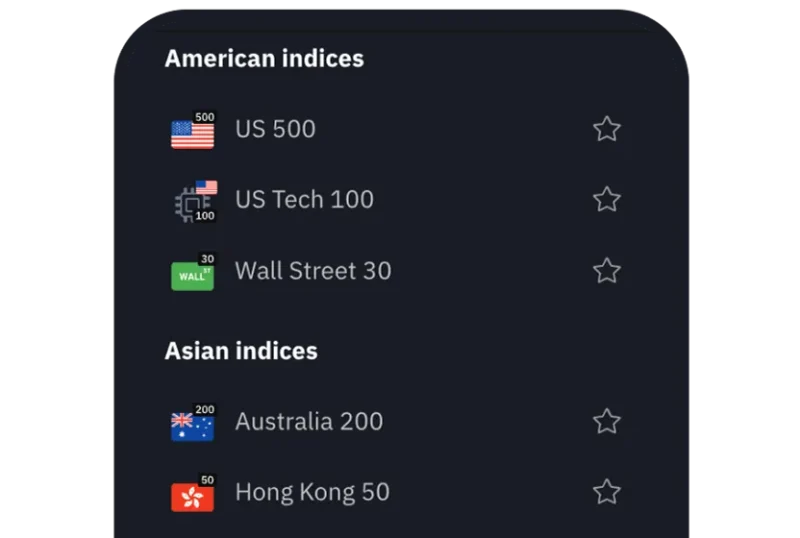
Phone listing stock indices including US 500, Wall Street 30, Australia 200 and Hong Kong 50

Negative balance protection

Protect your account from unexpected market swings.

What we offer

North America

North American indices range from Wall Street’s powerhouses to Silicon Valley’s tech titans.

Europe

European indices offer a diverse trading landscape, covering indices from London’s financial hubs to Berlin’s innovation centres.

Asia Pacific

A region on the rise, Asian indices represent the world’s fastest growing economies.

Explore our stock indices

Showing 1- 10 of 18
Instrument
Contract size
Base currency
Min size
Vol limit
Min spread
Target spread in %
Max effective leverage
Margin required (%)
Swap long (pts)
Swap short (pts)
Trading hours (gmt)
Australia 200
1AUD0.12001.550.03%1:2000.50%-6.672.31Sun 22:00 - Fri 21:00 GMT. Daily break 21:00 - 22:00
China H Shares
1HKD0.15007.470.12%1:1001.00%-5.040.97Sun 22:00 - Fri 21:00 GMT. Daily break 21:00 - 22:00
DXYUSD
1USD1100000.0530.06%1:2500.40%-22.000.18Sun 22:10 - Fri 20:50 GMT
Europe 50
1EUR0.15001.380.04%1:2000.50%-4.370.42Sun 22:00 - Fri 21:00 GMT. Daily break 21:00 - 22:00
France 40
1EUR0.11001.080.05%1:2000.50%-4.370.42Sun 22:00 - Fri 21:00 GMT. Daily break 21:00 - 22:00
Germany 40
1EUR0.11001.70.01%1:2000.50%-4.370.42Sun 22:00 - Fri 21:00 GMT. Daily break 21:00 - 22:00
Hong Kong 50
1HKD0.11005.780.04%1:1001.00%-5.040.97Sun 22:00 - Fri 21:00 GMT. Daily break 21:00 - 22:00
Japan 225
1JPY1050007.610.02%1:2000.50%-2.94-0.91Sun 22:00 - Fri 21:00 GMT. Daily break 21:00 - 22:00
Netherlands 25
1EUR0.11000.370.05%1:1001.00%-4.370.42Sun 22:00 - Fri 21:00 GMT. Daily break 21:00 - 22:00
Spain 35
1EUR0.11005.50.03%1:1001.00%-9.50-1.45Mon 06:00 - Fri 18:00 GMT

How to trade stock indices on Deriv

CFDs

Speculate on the price movements of popular stock indices with high leverage and advanced technical indicators.

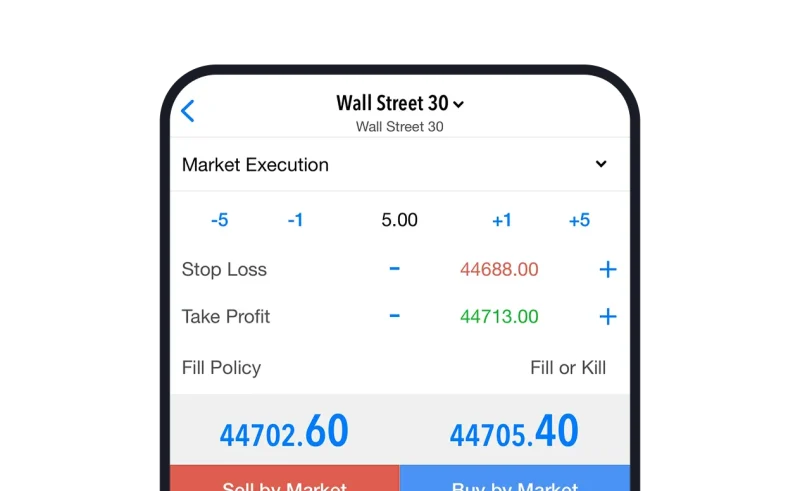
Deriv MT5 order ticket on mobile for Wall Street 30 with stop loss and take profit set

Options

Predict the market trends of stock indices without risking more than your initial stake.

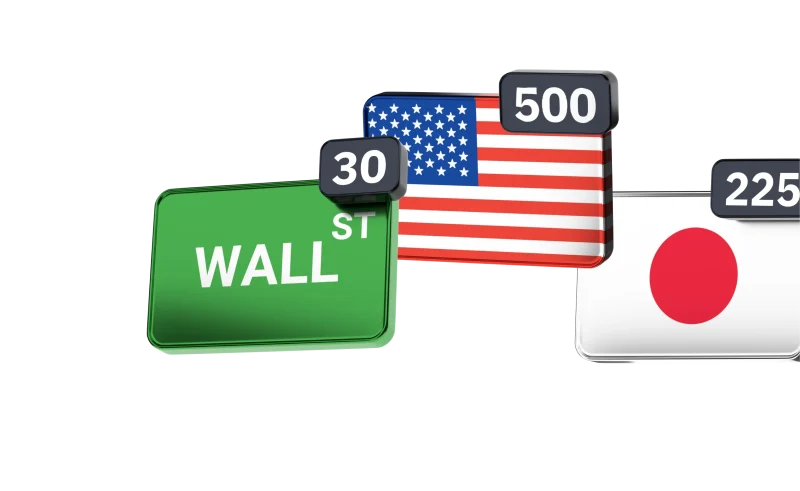
Wall Street 30, US 500 and Japan 225 index tiles shown with their country flags

Stock indices FAQs

Stock indices are groups of stocks that represent part of the financial market and track the performance of a group of stocks. For example, the S&P 500 follows the stocks of 500 large US companies. When people refer to 'market' performance in stock index trading, they often mean how major indices like the S&P 500 are doing. Traders can buy and sell instruments that track indices, speculating whether an index will rise or fall. How stock indices work: Indices are weighted to reflect the size and price of the stocks within it. In the S&P 500, larger companies have more influence based on their total market value. This is called market capitalisation weighting. In the FTSE 100, stocks are weighted purely by their share price. Expensive stocks carry more weight. Instead of picking individual stocks, traders can use indices to invest in many stocks at once. Index performance reflects overall market trends. There are also exchange-traded funds (ETFs) that mimic indices. ETFs provide a simple way to gain broad index exposure without buying all the stocks directly.
When trading CFDs on stock indices, there are a few CFD trading fees to be aware of: Spread: This is the difference between the buy and sell price quoted by the broker. It represents the transaction cost each time you open or close a trade. Overnight financing : To keep a trade open overnight, a financing charge will be applied based on benchmark rates plus a markup (swap-free accounts do not have this charge). This compensates the broker for the cost of holding your position overnight. Commissions : Some brokers charge commissions per trade, but Deriv offers commission-free CFD trading. Currency conversion : When trading in foreign markets using a different base currency to your account, currency conversions may incur fees and forex risk between your account currency and the instrument's currency.
The most popular indices to trade depends on where you are and which trading platform you use. However, some well-known examples include: S&P 500 Index (USA) DJIA Index (USA) NASDAQ Composite (USA) FTSE 100 (UK) DAX 40 Index (Germany) CAC 40 Index (France) Nikkei 225 (Japan) HSI Index (Hong Kong) The S&P 500 Index is one of the most widely followed indices in the world. It represents the 500 largest US companies and is commonly used as a benchmark for the overall US stock market.
Indices combine the prices of a group of stocks into a single value representing the overall market or sector. There are two main ways for how indices are calculated: Price-weighted indices simply average the share prices of all the companies included. So, each stock contributes equally to the index, regardless of the company's size. The Dow Jones Industrial Average is a famous price-weighted index. Market-capitalisation-weighted indices (also called market-cap weighted) are calculated differently. Rather than treat each stock equally, they give more weight to larger companies based on their total market value. So, the share price of a huge company like Apple contributes more to the index value than a smaller company. The S&P 500 is a well-known market-cap weighted index — it tracks the 500 largest US companies, so bigger firms have more influence on the index. The choice of the indices calculation method can significantly impact how an index performs. But both price-weighted and market-cap-weighted indices are widely followed by traders and investors looking to understand market movements.
WhatsApp