Trade global stocks

Tap into stock CFDs on your favourite brands like TSLA, AMZN, and AAPL. Manage risks while enjoying tight spreads and the flexibility to go long or short on global stocks across industries.

Why trade stocks with Deriv

High leverage

Maximise your stock market exposure with high leverage and super tight spreads.

Small and large red spheres on a metal lever, standing for high leverage up to 1:1000

Controlled risk, unlimited opportunities

Set your limits and manage your trades with take profit and stop loss features.
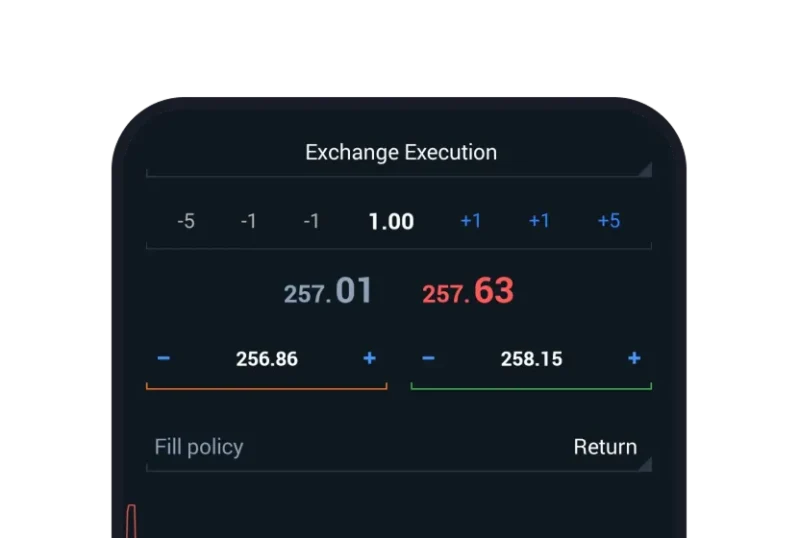
Deriv MT5 order ticket with stop loss and take profit set around a stock's bid and ask price

Negative balance protection

Protect your account from unexpected market swings.

What we offer

Technology

Tech stocks represent companies that lead the charge in digital evolution and breakthroughs.

Transportation & aviation

These companies connect the world, moving people and goods across borders.

Financial services

Trade the world's leading financial services companies, from banking and insurance to fintech.

Healthcare & pharmaceuticals

These companies are at the forefront of medical innovation and healthcare technology.

Consumer goods & retail

Consumer goods and retail companies mirror society’s trends and behaviours.

Entertainment & media

This sector represents companies that shape how we watch, listen, and play.

Explore our stocks

Showing 1- 10 of 457
Instrument
Contract size
Base currency
Min size
Vol limit
Min spread
Target spread in %
Max effective leverage
Margin required (%)
Swap long (pts)
Swap short (pts)
Trading hours (gmt)
AAL.OQ: American Airlines Group Inc (NASDAQ)
1USD550000.020.15%1:1010.00%-7.140.00Mon 13:30 - Fri 20:00 GMT
AAPL.OQ: Apple Inc (NASDAQ)
1USD12500.360.14%1:1010.00%-7.140.00Mon 00:00 - Fri 20:59 GMT. Daily break 21:05 - 21:30
ABBV.N: AbbVie Inc (NYSE)
1USD116000.20.13%1:1010.00%-7.140.00Mon 13:30 - Fri 20:00 GMT
ABNB.OQ: Airbnb Inc (NASDAQ)
1USD14000.240.18%1:1010.00%-7.140.00Mon 13:30 - Fri 20:00 GMT
ABT.N: Abbott Laboratories (NYSE)
1USD122500.040.06%1:1010.00%-7.140.00Mon 13:30 - Fri 20:00 GMT
ACGL.OQ: Arch Capital Group Ltd (NASDAQ)
1USD16000.140.18%1:1010.00%-7.140.00Mon 13:30 - Fri 20:00 GMT
ACN.N: Accenture Plc (NYSE)
1USD12000.390.27%1:1010.00%-7.140.00Mon 13:30 - Fri 20:00 GMT
ADBE.OQ: Adobe Inc (NASDAQ)
1USD18000.310.16%1:1010.00%-7.140.00Mon 13:30 - Fri 20:00 GMT
ADI.OQ: Analog Devices Inc (NASDAQ)
1USD18000.230.11%1:1010.00%-7.140.00Mon 13:30 - Fri 20:00 GMT
ADP.OQ: Automatic Data Processing Inc (NASDAQ)
1USD110000.110.08%1:1010.00%-7.140.00Mon 13:30 - Fri 20:00 GMT

How to trade stocks on Deriv

CFDs

Speculate on the price movements of popular stocks with high leverage and advanced technical indicators.

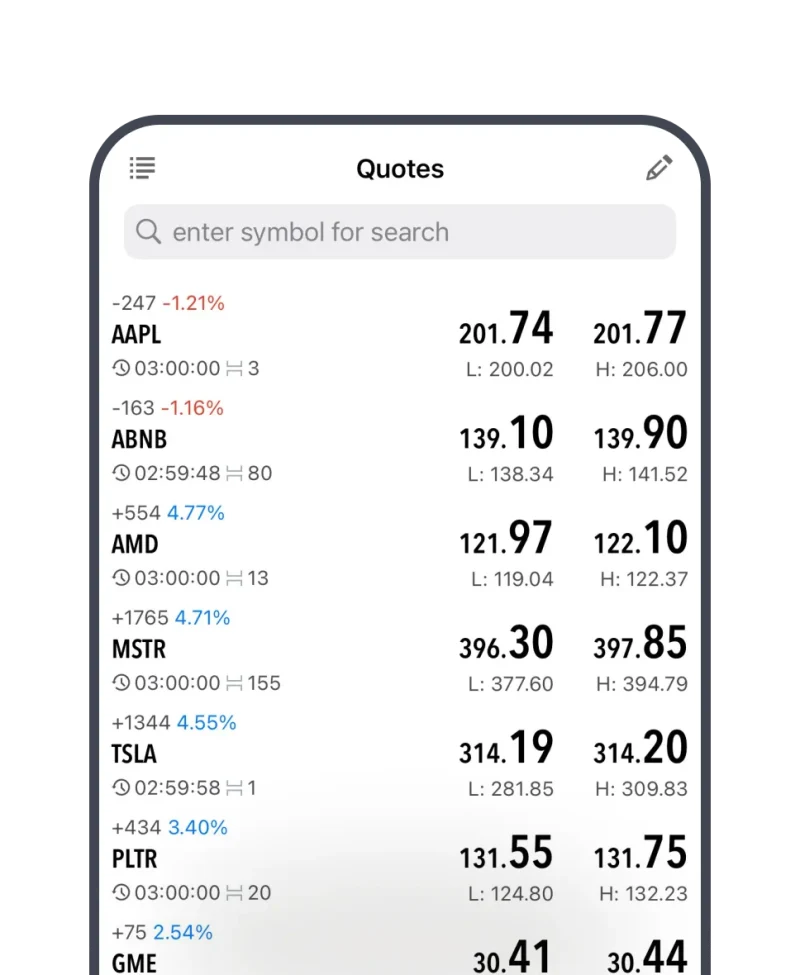
Phone showing MetaTrader 5 quotes for Apple, Airbnb, Tesla and other US stocks

Stocks FAQs

Stocks represent ownership and a claim to part of a company's future profits. When you purchase shares of a company's stock, you become a partial owner of that business.
The main differences between spot trading (trading the actual stocks) and trading contracts for difference (CFDs) are: Ownership : When you trade actual stocks, you buy and own the underlying shares and receive voting rights. With CFD trading, you don't own the asset; you are simply speculating on the stock's price movements. Leverage : CFDs allow you to trade with leverage, meaning you can control a larger position with less capital. When you trade actual stocks, it is usually on a 1:1 basis, although you can also have margin accounts which provide some leverage. Short selling : It is easier to short-sell CFDs than actual stocks. You need to borrow the share to short-sell real stocks, while CFDs do not have this requirement. Costs : Commission-free CFD trading has a spread cost and usually daily financing charges (except on swap-free accounts). Trading actual stocks typically have a narrower spread but also additional commissions and exchange fees.
When trading stocks on Deriv, you can access leverage of up to 1:10 across all available stocks. This means for every $1 in your account, you can control $10 worth of stock positions. This leverage is available on both the MT5 Standard and Swap-free accounts, giving you consistent trading conditions regardless of which account type you prefer. However, remember that losses can also be amplified.
No, when you trade CFDs on stocks, there are no dividends. CFD accounts are used for speculating on price movements rather than owning the underlying asset. So, they do not receive cash dividend payments like you would if you owned the actual shares. Instead, Deriv makes 'dividend adjustments' to CFD accounts to account for the impact of dividends. These adjustments are made on the ex-dividend date to ensure no extra profit or loss results from scheduled dividend events. For long CFD positions: If an underlying share issues a dividend, its price would normally decrease as funds leave the company. This would cause your long CFD position to show a loss. To offset this, Deriv credits your account with the amount of loss caused, keeping the value fair. For short CFD positions: If an underlying share issues a dividend, its share price would normally increase as funds are given to shareholders. This would cause your short CFD position to show a profit. So, Deriv debits your account by the amount of profit caused to keep the valuation fair. While CFDs do not pay dividends, understanding events like earnings seasons can still help you anticipate price movements.
Factors affecting stock prices include: Macroeconomic factors: These are big-picture factors that affect the economy as a whole, such as economic growth, inflation, interest rates, and currency exchange rates. Interest rates directly impact stock valuations through the discount rates used in valuation models. Inflation impacts input costs and future earning projections. Company performance factors: These include factors that are specific to individual companies, such as quarterly earnings results, profitability, revenue growth, product pipeline, and market share. Companies that are doing well financially and have good prospects for growth tend to have higher share prices. Investor sentiment and trading activity: This includes factors such as institutional buying or selling, individual investor enthusiasm or pessimism, and momentum and algorithmic trading. High demand for a stock or index can push prices up. Geopolitical events: These include events such as government policy changes, regulatory shifts, elections, wars, and trade agreements that can have an impact on the economy. Market volatility: Stock market fluctuations can be caused by crises, recessions, or events that cause uncertainty and panic selling. It is important to keep an eye on big-picture trends and company fundamentals to understand why do stocks go up and down. Categorising the many factors into the above buckets can provide a helpful perspective.

Join 3M+
global traders

Open an account in minutes and start trading the world's markets — forex, stocks, indices, and more.

WhatsApp